 There are many reasons that previously successful PPC campaigns turn into failing PPC campaigns.
Changes with the tracking setup, the product feed, needed adjustments in the bidding strategy, or other changes in the ad platform itself are among the many reasons this can happen.
When we review a failing PPC campaign, we look for the issues that are most likely to limit performance first. A campaign may have one major problem, or it may have multiple issues going on. We’ll seek to identify the primary issue first, then determine whether the campaign can be reengineered for better odds of success.
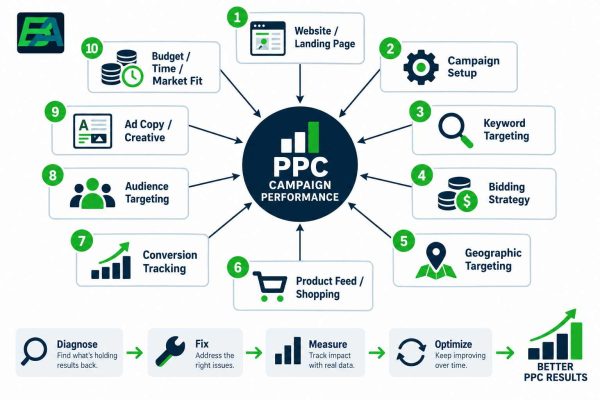
1. Website Implementation Problems
If a campaign has never performed well, it could of course be due to the website or landing page the campaign is driving traffic to. A PPC campaign can send qualified traffic, but the website still has to convert that traffic into leads, sales, or other meaningful actions.
Common website and implementation issues include:
- Landing pages that are unclear, slow, or difficult to use.
- Weak calls to action or confusing conversion paths.
- Campaigns sending traffic to pages that do not match the ad or keyword intent.
- Exposed email addresses on the site causing conversion tracking leakage.
- Forms, phone tracking, or conversion actions that are not working properly.
The landing page experience is a crucial factor. If a campaign drives traffic to a poorly designed landing page, that creates friction (at best), so even a well-engineered campaign can struggle to become profitable.
2. Account and Campaign Setup Mistakes
Some failing PPC campaigns were configured incorrectly from the start. Or, the wrong campaign type, bidding method, schedule, targeting, or other account settings were used.
Campaign setup mistakes we see frequently include:
- The wrong type of campaign was deployed for the business goal.
- A search campaign was used when a Shopping campaign would have been more suitable.
- The campaign was scheduled incorrectly or turned off during important selling periods.
- The bidding strategy wasn’t appropriate.
- Account-level or campaign-level settings were overlooked.
- The business model was not well matched to the selected marketing channel.
- The campaign was built without considering whether paid search, paid social, Shopping, display, or video would have been a better fit.
Campaign structure matters because it affects bidding, budget control, search query matching, reporting, and optimization. If the foundation is wrong, all bets are off.
3. Keyword Targeting Mistakes
Keyword targeting problems are one of the most common reasons search campaigns fail. Many campaigns are configured in ways that lead to spending too much on irrelevant traffic.
Common keyword mistakes include:
- Insufficient market and keyword research.
- Only partial keyword coverage for the actual available search market.
- Pausing or changing keywords before enough impression and click data exists.
- Making decisions without having data with enough “statistical power” over time.
- “Keyword silo overlaps” that cause internal competition or keyword mispricing.
- Not utilizing a few core keywords that should form the backbone of a campaign.
- Pausing “conversion-assist keywords” before their role is understood.
- An insufficient, or (worse) faulty negative keyword base.
- Spending on keywords with too little related search query volume for the geographic area being targeted.
Keyword targeting should be based on search intent, market size, and conversion potential. A keyword that looks logical may still be too broad, too expensive, too low-volume, or too disconnected from the best conversion path.
4. Bidding Mistakes
In many failed PPC campaigns, bidding type, or configuration mistakes cause a campaign to overspend, underserve, collect poor data, or simply move onto automated bidding before the account is ready.
Common bidding mistakes include:
- Bidding too conservatively, leaving the best clicks for competitors.
- Failing to establish a baseline with manual or semi-automated bidding, before using automation.
- Switching to automated bidding before enough conversion volume exists.
- Using maximize-conversion strategies without understanding whether they fit.
- Using the wrong bidding strategy for an ecommerce or Shopping campaign where margins vary by product.
- Not comparing manual performance to automated bidding performance.
Automated bidding can be useful, but it needs the right structure and enough reliable conversion data. If the campaign is moved into automation too early, or if the conversion data is incomplete, the bidding system may optimize around weak or misleading signals.
We have written some articles about this, including adjusting PPC campaign bids and automated bidding timelines.
5. Geographic Targeting Mistakes
Geographic targeting can easily have a major impact on PPC campaign performance. A campaign may fail if it spends too much in areas that are expensive to convert, too broad for the available budget, or not aligned with the business model.
Common geographic targeting mistakes include:
- Failing to refine geographic targeting for efficiency.
- Spending too much in locations that are unlikely to convert.
- Not optimizing dense metro areas down to the ZIP code level when appropriate.
- Targeting multiple countries in one campaign when they are not culturally or economically similar.
- Targeting too large a geographic area for the available ad spend.
Geographic targeting should fit the campaign budget, the service area, the market size, and the conversion economics. A larger target area is not always better. Especially when available budget is inadequate. This is something we see frequently in struggling campaigns – too large of geo for the budget.
6. Product Feed and Shopping Campaign Mistakes
Shopping campaigns can fail when the product feed, campaign structure, or product partitioning does not match search demand, margin, or available budget.
Common product feed and Shopping campaign mistakes include:
- The product set being advertised wasn’t built with search query volume in mind.
- The Shopping feed was not optimized effectively, to get the ads into the right auctions.
- Too many SKUs were advertised relative to the daily spend level.
- A few SKUs consumed most of the ad spend, leaving many starved for budget.
- Product groups weren’t structured properly.
Shopping campaigns depend upon the quality of the product feed, and how products are grouped, prioritized, and funded. If too many products are competing for too little budget, the campaign may not collect enough useful data to optimize properly.
Related topics include Shopping campaigns and product feeds.
7. Conversion Tracking Mistakes
Conversion tracking problems can make it difficult or impossible to understand whether the campaign is working. In some cases, the campaign may be generating value, but the account does not have the data needed to prove it. In other cases, bidding systems may be optimizing from incomplete or inaccurate signals.
Common conversion tracking mistakes include:
- Conversion tracking is only partially implemented
- Conversion actions are not tested periodically
- Forms or tracking actions stop working over time
- Tracking is not tested in popular browsers as part of CRO review
- Lead generation conversions are not assigned a meaningful value
- Conversion values do not relate back to the advertiser’s average conversion value over time
- Attribution is too limited to show the role of assisting keywords or campaigns
- Third-party call tracking is not used when phone leads represent a significant share of conversion value
When conversion tracking is incomplete, the campaign can run open loop. That means the account is spending money without enough performance feedback to support optimization, bidding decisions, or accurate reporting. Related topics include campaign performance tracking and web analytics.
8. Audience Targeting Mistakes
Audience targeting mistakes are especially relevant with display, video, remarketing, and other audience-driven campaign types. If the audience doesn’t align with the actual market, the campaign can spend heavily without reaching prospective buyers.
Common audience targeting mistakes include:
- Selecting the wrong audiences for the product or service.
- Treating audiences as “set-and-forget” without adequate testing.
- Building audiences that don’t correlate with the target market or buyer personas.
- Not testing different audience types, such as in-market, affinity, placement, demographic, remarketing, or using “custom segment” targeting methods.
- Failing to measure and use demographic signals incluing age, income level, and other relevant audience patterns.
In our experience, audience targeting requires a lot of trial and error. It’s important not to settle for just using audiences that seem good in theory. They have to be tested in order to arrive at audience segments that prove to support engagement, conversion activity, and profitable campaign performance.
9. Ad Copy and Creative Mistakes
Ad quality affects click-through rate, quality signals, engagement, and conversion potential. Weak ad copy will reduce click-through rates (engagement), damaging campaign efficiency. In display and video campaigns, the creative is even more important because there is less immediate search intent.
Common ad copy and creative mistakes include:
- Average or generic ad copy that produces weak click-through rates.
- Failing to split-test ad copy, exploring alternate value propositions.
- Changing ad copy without first statistically verifying baseline performance.
- Missing, poorly written, or poorly implemented ad extensions.
- Using the wrong images. As with audiences, images require testing.
- Using polished TV-style video ads that don’t work well in online video media.
- Overlooking the importance of images in display campaigns where visual engagement is central.
Display and video ads need creative that fits the digital environment. Expensive production values don’t translate into better online performance.
The creative needs to pull attention, support the message, and fit the way users interact with ads online.
10. Commitment, Budget, and Market Fit Mistakes
Many failed PPC campaigns are encumbered by multiple technical issues. Other times it’s just a poor market fit.
Common commitment and market-fit mistakes include:
- The agency or campaign manager was not given enough time to optimize the campaign.
- The campaign was judged before enough data was available.
- The ad budget was not large enough to get over the success threshold.
- The product or service was not in demand.
- The offer was not competitive enough for the targeted market.
- The campaign was operating in a highly competitive market, requiring a longer optimization period.
PPC campaigns carry business risk. Not every campaign succeeds quickly, and some markets take time to prove out. A sound approach includes enough budget, time, a quality tracking setup, and a strong value proposition that can compete in the market being targeted.
Related topics include positive PPC ROI and where to set PPC ad spend.
How Blastoff Advertising Reviews Failed PPC Campaigns
When weconsider taking on a PPC project, we don’t want to get involved in campaigns that are structurally destined to fail. That would disappoint a client and waste everyone’s time, budget, and attention. So, one of the first things we look at is the quality of the campaigns, and the performance history.
Before we take on a PPC account turnaround project, we want to be sure there’s reasonable evidence that the campaign can be improved. That doesn’t mean every project works out as expected, but there should be clear reasons to believe the account can move toward better performance.
On the other hand, we see past failures should be treated as information, not as a permanent verdict. With the right review, restructuring, tracking, and optimization process, an underperforming campaign can often become a strong-performing business asset.
Related Topics
Related topics include PPC campaign management, campaign performance tracking, positive PPC ROI, PPC ad spend, and PPC performance.