Still Adjusting PPC campaign bids??
 Management of PPC campaign bids has changed substantially over the past several years. Today, Google Ads increasingly relies on automated bidding, but that doesn’t mean every new campaign should necessarily launch with automated bidding.
Manual bidding has become a sort of “Rodney Dangerfield” of bidding methods; it “just doesn’t get any respect”. But there are times when it still serves useful purposes.
Today, automated bidding is usually going to be the option for delivering campaign performance. But there are times, and situations where it makes sense not to use automated bidding.
We select a bidding strategy based on the state of a campaign (and the account it sits in), its conversion history, traffic volume, keyword structure, budget, and business objective.
Especially with new campaigns, we often deliberately launch with Manual CPC bidding. Yes—manual bidding. Positively old-fashioned, by some accounts.
Why We Rebelliously Launch New Ad Campaigns On Manual CPC Bidding (sometimes)
Google’s automated bidding systems can begin serving ads in a new campaign without established conversion history. Starting with automation is the prevailing recommendation.
And often, that works well. In practice, however, we’ve found that it isn’t always the best way to launch a new campaign.
So sometimes, we start by manually controlling PPC campaign bids.
Allow us to explain this departure from widely-practiced methods.
Upon launching a new campaign, running bids with Manual bidding can be beneficial, particularly with larger search campaigns containing many ad groups and keywords. Or Shopping/PMax campaigns with many SKUs.
When automated bidding is introduced immediately, Google may concentrate spending on a relatively small portion of the keyword (or SKU) base it’s automation deems to be most likely to produce conversions.
The problem with that is, a brand-new campaign has little campaign-specific data on which to make those decisions. When you launch a new ad campaign on automated bidding, there’s no baseline reference.
We therefore, often manage PPC campaign bids with Manual CPC for the first week or two. This gives us more direct control over where the initial advertising dollars are spent, and importantly, by adjusting the manual CPC’s properly, forces traffic to serve across a larger percentage of the keyword base, or SKUs in the case of eCommerce campaigns.
The manual bidding phase is in effect priming the campaign, while at the same time generating a performance baseline in advance of it running on automated bidding.
The baseline data is useful in several ways.
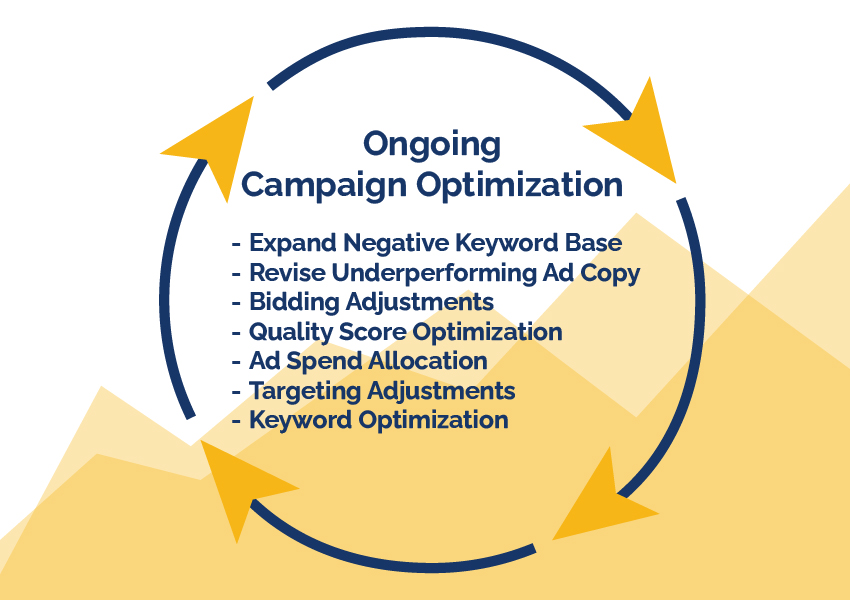
While running PPC campaign bids campaign on Manual CPC, we’re observing which search terms and keywords attract useful traffic, and starting to build out a negative keyword base to block wasteful matches to irrelevant search terms. We’re generating a baseline of metrics that have been served more broadly across the keyword and/or SKU base. This baseline will later allow us to make better decisions with automated bidding.
This process is closely related to our article about new PPC campaigns need enough clicks, conversions, and time before campaign performance assessment treated as legit.
What Happened to Enhanced CPC?
Enhanced CPC (also referred to as ‘eCPC’ or ‘e-CPC’) was a popular method for managing PPC campaign bids. A step beyond Manual CPC. It was deprecated by Google in 2025. It is best described as “semi-automated” bidding method. Target Impression Share is another one of those.
Enhanced CPC bidding used to provide a useful middle ground between Manual CPC and fully automated bidding. With eCPC bidding, advertisers established manual bids, but Google could adjust those bids when its system predicted a greater or lesser likelihood of conversion. So they took the bid into account, but if odds for a conversion were high (based on the metadata for that auction), they would bid more aggressively. This worked quite well, and provided a sort of middle-ground, or transition step between manual bidding and automated bidding.
Google discontinued eCPC for Search and Display campaigns in 2025. Campaigns that weren’t moved to another bidding strategy reverted to Manual CPC.
So now, there is a larger gap between Manual and Automated bidding. However, by setting PPC campaign bids skillfully while on manual bidding, we can accrue most of the benefits that e-CPC bidding offered. And for certain purposes, Manual CPC bidding can be a superior choice vs using eCPC; but we won’t go into that here.
When Do We Move to Automated Bidding?
We like to see 15 to 30 conversions out of a manually-bid campaign before moving it onto automated bidding. 30 is a lot better. Below that, the risk is the baseline metrics, especially those relating to conversion performance, lack “statistical power”. We can estimate that, by running a standard deviation and confidence interval calculation. In most cases, 30 conversions is a minimum; and often more is required. By then, we will usually have accumulated a statistically significant set of conversion metrics (it has “statistical power”) for the baseline metrics.
We evaluate the campaign data statistically, rather than automatically switching strategies after a predetermined number of days.
Once there is enough useful information, automating management of PPC campaign bids using strategies such as Maximize Conversions, Target CPA, Maximize Conversion Value, or Target ROAS can be useful.
Automated bidding is where most campaigns should end up. You don’t want to be manually adjusting bids, long-term if at all possible.
Instead of spending most of our time adjusting individual keyword bids, we’re increasingly managing the inputs and constraints that influence the bidding system:
- Conversion goals and conversion tracking
- CPA or ROAS targets
- Campaign budgets and budget allocation
- Conversion values
- Search-term and traffic quality
- Campaign and ad group structure
- Keyword coverage
- Product segmentation in Shopping campaigns
- The quality of the conversion data being supplied to Google
Automated bidding is good, but accurate PPC conversion tracking has become critically important. Automated bidding the accuracy of conversion actions and conversion values it received.
Do We Still Monitor PPC Campaign Bids With Automated Bidding?
Absolutely. But there are downsides to watch out for.
Especially after Google’s August, 2026 major change to how automated bidding works, it can sometimes produce CPCs well above what we would expect, and what was printed historically in an account. If CPCs rise 20%, CPA will rise 20%. So we monitor the metrics and benefit from having a manual CPC baseline in mind, rather than simply assuming Google’s bidding decisions are appropriate.
Where available, bidding controls and portfolio strategies can provide additional ways to constrain automated bidding. The appropriate solution depends on the campaign and bidding strategy being used.
Is Managing PPC Campaign Bids Manually Obsolete?
Changing hundreds of individual keyword bids manually is less likely to be a good use of time, than it once was. Automated bidding allows us to spend little time managing PPC campaign bids, freeing up attention for higher-leverage campaign management activities.
But it’s still unwise to blindly trust automated bidding without having a reference point. With a reference point, then we always know what the automated bidding is doing for us. Or, not. And we can generate a reference point by briefly running campaigns on automated bidding.
One benefit from running a campaign on Manual bidding for a short time is, we can force the ad spend to serve across a broader cross-section of keywords and/or SKUs. This creates a stronger foundation for automated bidding to key off of, when we make the transition onto automated.
Without that priming period, we’ve found that automated bidding algorithms often fail to do enough “discovery” and will serve too narrowly on a certain set of keywords/SKUs, or ads.
So by starting with a manual bidding phase, when we transition a campaign onto automated bidding it may be able to reach higher levels of performance. Because we started it from a stronger dataset.
Manual bidding can serve other useful purposes, but those are topics for other articles!
Related Topics
Related questions include how long it takes to reach automated bidding, how campaign performance is tracked, and PPC campaign management.