
Display campaign ads require a different creative process than search ads because display advertising has to earn attention before it can generate action. Search ads respond to expressed intent. Display ads usually appear while users are browsing, reading, watching, comparing, or doing something else online.
That makes creative quality especially important. The image, headline, description, brand cue, call to action, and landing page all have to work together quickly enough for the user to understand the message and decide whether it is relevant.
Google is also changing where Display campaign ads live. Beginning in June 2026, Google started rolling out tools that allow eligible advertisers to migrate standalone Google Display Ads campaigns into Demand Gen. Google has left the mandatory timing open for now: it has said that new standalone Display campaigns will eventually have to be created within Demand Gen and that remaining eligible Display campaigns will later be migrated automatically, but it has not published a firm date for those steps.
The important point is that Display advertising itself is not disappearing. Google Display Network inventory remains available within Demand Gen, including the ability to run Display-only campaigns. The creative principles discussed here therefore remain relevant whether the ads are running in a traditional Display campaign today or through Google Display Network inventory inside Demand Gen.
The display ad channel is fundamentally different from the search ad channel. Display ads deliver advertising messages to audiences who may have a related need or interest but have not necessarily expressed direct search intent.
Why Display Campain Ads Works Differently
Search ads are displayed on search engine results pages that the person searching has requested. The user has already entered a query and created an opportunity for an advertiser to respond directly to that intent.
Display ads are usually shown in an environment where the user did not specifically ask to see the advertisement. Because of that difference, display campaign ads have to accomplish several things very quickly. They must attract attention without becoming distracting, communicate the main idea, establish relevance, and give the right audience a reason to engage.
This is why display campaign ad design cannot be treated simply as graphic design. Strong creative connects the offer, audience, visual message, brand, call to action, and landing page experience.
Our Process for Designing Display Campaign Ads
We have tested different approaches to inventing, improving, testing, and optimizing display campaign ads. Our process is based partly on the classic creative process, but adapted to digital advertising where creative decisions can be tested against actual campaign behavior.
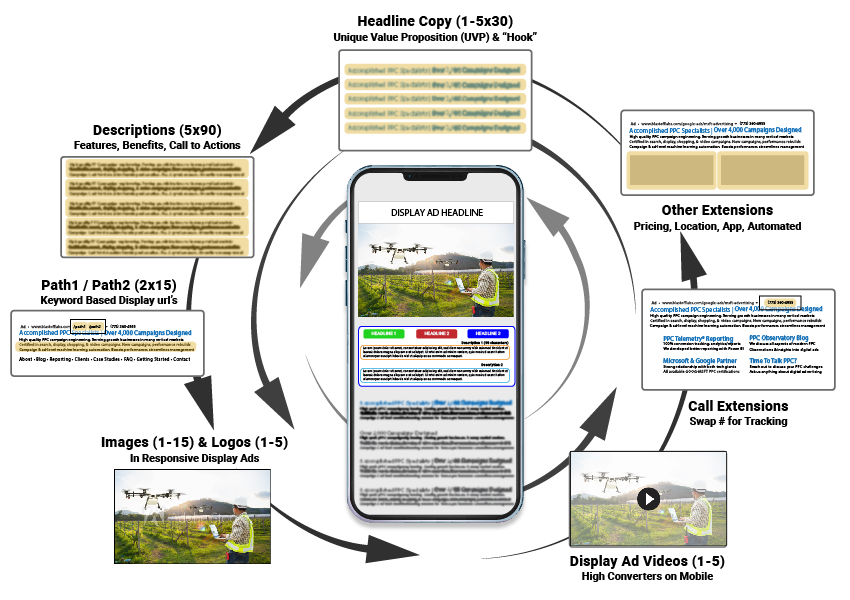
Our process shown in this diagram, begins with headline development and then moves counterclockwise through the other major components of the ad. Importantly, the process is often recursive. Once ads begin serving, what we learn from campaign data can cause us to revisit the headline, imagery, descriptions, call to action, landing page, or another part of the creative.
In other words, display ad development is rarely a one-time sequence that ends when the ad launches. It is a cycle of creative development, observation, testing, and refinement.
Start With the Headline
We start with Headline copy because the headline establishes the core idea of the advertisement. It usually needs to communicate some combination of the unique value proposition, the offer, and the reason the intended audience should pay attention.
A strong headline shouldn’t necessarily be “clever copy”. It needs to answer a more basic question: why should someone care about this message?
For responsive display ads, multiple headline variations can be created and tested. That allows different versions of the value proposition or creative hook to compete against one another as the campaign gathers data.
The strongest headline directions are usually those that are specific enough to communicate value while still being short enough to work across different placements and screen sizes.
Develop Descriptions Around Features, Benefits, and Action
Once the main headline direction is established, the descriptions expand the message. This is where features, benefits, supporting points, and calls to action come into play.
Descriptions should never just repeat the headline in longer form. They should add information that helps the user understand why the offer matters or what they should do next.
Depending on the campaign, useful description variations may emphasize:
- A specific product or service benefit
- A differentiating feature
- A problem the advertiser solves
- A credibility point or proof element
- A promotional offer
- A next step or call to action
Multiple description variations can also reveal which benefits or messages resonate the best with your audience.
Use the Display URL and Paths to Reinforce the Message
The visible URL and path fields are small parts of an ad, but they can help reinforce relevance and context.
Where the format allows it, path language should support the ad’s message rather than simply repeating a generic website address. Relevant path terms can help clarify what the user should expect after clicking.
This matters because every visible element contributes to the user’s interpretation of the ad. A headline may establish the promise, while the displayed path can reinforce the category, service, product, or destination.
Select Images and Logos That Support the Offer
Images are the most visually dominant element in a display campaign ad, so they need to do more than simply look attractive.
The image should support the advertising message. It may show the product, demonstrate the service, represent the intended customer, visualize the outcome, or establish an emotional context that makes the headline easier to understand.
Images that are visually interesting but unrelated to the offer will gain attention without generating useful engagement. That can produce impressions and clicks without improving conversion performance.
What has worked for us is to ask ourselves: “What thought do you want to put into someone’s head, when they glance at this image?”. Assuming they may be interested in the product or service. Which is the targeting’s job.
Responsive display formats may also use several image sizes and multiple logos. That gives the platform some flexibility to assemble ads for different placements, but it also means the creative assets need to remain coherent when combined in different ways.
The goal is not simply to provide Google with the maximum number of assets. The goal is to provide a useful range of strong assets that communicate the same underlying message.
Add Video When It Improves Communication
Video can extend the same creative concept into placements where motion, demonstration, or storytelling is useful.
Short videos can work particularly well when the product or service benefits from being shown in use, when motion helps explain the offer, or when mobile users may respond better to video than to a static image.
In our experiences, short videos recorded with a phone, made by someone who really knows what’s unique about the product, can be highly effective for eCommere. Think, “quick, informal, elevator speech”. Telling what’s unique and appealing about this product.
Video should still connect directly to the same core message as the headline, images, descriptions, and landing page. Adding video merely because the format is available does not automatically improve a campaign.
Within Demand Gen, this becomes increasingly relevant because campaigns can combine Google Display Network inventory with visual placements across YouTube, Discover, Gmail, and other Google surfaces.
Use Extensions and Supporting Assets Where They Add Value
Depending on the campaign type and available format, additional assets can provide useful information such as locations, pricing, app information, or other supporting details.
These elements should strengthen the primary offer rather than overload the advertisement. The main message still needs to remain clear.
One useful principle is hierarchy: the viewer should understand the core value proposition first, then see supporting information second. If every element is competing for equal attention, the ad can become harder to process.
Display Campaign Ads Need to Earn Attention Before They Can Drive Action
Search ads appear after someone has already entered a query. Display ads usually appear while the user is doing something else online. That means a display ad first has to earn enough attention for the person to process the message.
Visual communication therefore is critical. The image, headline, offer, brand cue, and call to action should work together so that the user can understand the core message quickly.
If the visual hierarchy is unclear, the campaign may still generate a large number of impressions, but those impressions may not translate into meaningful engagement.
Display Ads Should Match the Landing Page Experience
A display ad can create interest, but the landing page has to continue the same conversation.
If the advertisement communicates one idea and the landing page introduces a substantially different message, users may hesitate or leave. Strong display campaign design therefore connects the ad, offer, landing page, and conversion path.
Message match helps reassure users that they arrived in the right place after clicking. The headline, imagery, terminology, offer, and call to action on the landing page do not need to duplicate the ad exactly, but they should feel like a logical continuation of it.
This is one reason we also consider display campaign CRO feedback when evaluating creative performance. Sometimes an ad is doing its job successfully, but the post-click experience is preventing that interest from becoming a conversion.
Testing Creative Variation In Display Campaign Ads
Display campaign ad should not rely only on design decisions. Once ads begin serving, different creative directions can be tested against actual audience behavior.
Different audiences may respond to different combinations of imagery, headlines, offers, calls to action, and landing page messages. Testing helps identify which direction generates useful engagement and conversion behavior rather than simply which advertisement looks best in isolation.
Elements that may be tested include:
- Headline and value proposition
- Offer framing
- Image style
- Visual hierarchy
- Branding emphasis
- Description copy
- Call-to-action language
- Ad format and size
- Video versus static creative
- Audience-specific variations
- Landing page message match
This testing is closely related to display campaign optimization and automation. Creative should not be evaluated separately from the campaign that is serving it.
The Creative Process Is Recursive
One of the most important ideas represented in our display ad development diagram is that the process loops back on itself. It become “iterative”.
A campaign may begin with a headline and a particular visual concept. After the ad serves, we may learn that one audience responds strongly to the headline but not the image. Another variation may generate clicks but weak conversion behavior. A different landing page may reveal that the offer itself needs to be reframed.
That information can cause us to return to an earlier stage of the process and revise it.
For example, campaign data may lead us to:
- Rewrite headlines around a stronger value proposition
- Emphasize a different customer benefit
- Replace imagery that attracts the wrong type of click
- Change the call to action
- Create audience-specific creative
- Improve message match with the landing page
- Develop a video variation from a successful static concept
This iterative loop is one of the main advantages of digital advertising. The creative process does not need to depend entirely on subjective judgment. It can become increasingly informed by real user behavior.
Display Ad Design Should Reflect the Campaign Goal
Not all display campaign ads are expected to perform the same job. Some campaigns support awareness or prospecting. Others are designed for remarketing, lead generation, product consideration, direct sales, or assisted conversions.
The creative should reflect that role. A prospecting ad may need to introduce the advertiser and explain the offer clearly. A remarketing ad may be able to assume greater familiarity and focus on the reason the user should return.
A campaign aimed at generating immediate leads may use a stronger direct-response call to action than a campaign whose purpose is to introduce an unfamiliar product to a new audience.
That’s why creative for display campaign ads can’t be evaluated solely by click-through rate. Depending on the campaign objective, we may also consider conversion behavior, conversion quality, assisted conversions, audience performance, post-click engagement, and the role the campaign plays in the broader conversion path.
A Practical Design Checklist For Display Campaign Ads
- Make the primary message easy to understand quickly.
- Match the creative to the audience and campaign objective.
- Use a headline that communicates a clear value proposition or hook.
- Use descriptions to add benefits, proof, or a next step.
- Select images that support the offer rather than distract from it.
- Keep branding visible without allowing it to overpower the message.
- Use a clear and realistic call to action.
- Align the ad with the landing page experience.
- Create multiple strong variations for testing.
- Evaluate creative using campaign and conversion data, not aesthetics alone.
- Be prepared to revisit earlier creative decisions as new information becomes available.
Designing Display Campaign Ads as a System
The most effective display campaign ads aren’t usually the product of one isolated creative decision. They emerge from a system that connects headline development, descriptions, imagery, branding, video, supporting assets, audiences, landing pages, and campaign performance.
That is why our process is intentionally iterative. We begin with a strong creative hypothesis, launch multiple variations, observe how the audience responds, and use that information to refine the next round of creative.
For related information, visit Blastoff Advertising’s display campaign ad development, display ad targeting planning, display campaign audience configuration, display campaign optimization and automation, display campaign reporting, and display advertising results.
