
Responsive display ads first arrived as a new beta display ad type in Google PPC display campaigns in 2018. Responsive search ads were then introduced by Google and rolled out by Microsoft in mid-2019.
The ad platforms have been surprisingly tight-lipped about their purpose, and they have been designated “beta” status for much of their existence. Analytics about the performance internals are limited and a bit sketchy.
Responsive search ads were not originally stand-alone replacements for traditional extended text ads, or ETAs. Rather, they augmented them and could be utilized as a sort of ad copy split-testing machine. Display responsive ads are a bit different, providing a more efficient way to deploy display ads and capable of entirely replacing the previous generation of display ads.
But now, as of July 1, 2022, responsive search ads are the only way advertisers are allowed to create search campaign ads. Tight control of ad copy and placement has been taken away from advertisers, with the PPC platforms preferring to do it themselves with proprietary algorithms. This is a controversial change for a number of reasons.
Both search and display responsive ads, when rendered, look the same as other display and text ads. However, the images, text, and video content within responsive ads can be served differently by the ad platform each time an ad is served. Responsive ads can also adjust their form factor and size to fit onto a broader range of devices and screen sizes. These self-train and serve adaptively, with the goal being to deliver better performance.
Display responsive ads can serve in native format on web pages across the display network, fitting into the style of web pages better than previous generations of ads. For more related topics, see Blastoff Advertising’s display ad campaigns articles.

Responsive Ad detail on Mobile
Why Were Responsive Ads Introduced?
Of all the ads running in PPC campaigns across Google and Microsoft, many campaigns have poorly written and/or low-performing ad copy. This is not surprising, as ad copy development is a learned skill, and many advertisers do not have the experience or knowledge needed to consistently develop strong ad copy.
Responsive ads are an attempt to, at least in part, improve the performance of campaigns by bringing some automation into the testing of ad copy. This makes sense when you consider the immense scale of ads running globally on the two largest ad platforms today.
When run alongside extended text ads, responsive ads should be populated with about one-third of the strongest copy used in extended text ads, with the rest of the copy being new and perhaps untested. The responsive ad will serve as a sort of split-testing machine, discovering the best of the new copy to serve with the known strong copy.
The Chameleon-Class Ad Type
This new variant of search and display ads is responsive in several ways. Responsive ads can adapt their size and form factor to display on more device types and search engine result pages. Responsive display ads can also render in native styles on web pages across display networks.
Available ad display space varies by device type and screen size and is especially significant for display ads. Responsive ads can adjust their size and form factor to fit into the available screen real estate. They do this by adjusting their ad unit size, aspect ratio, and the number of ad copy fields displayed.
This allows them to have a greater reach, serving onto more device screens when compared to standard ads. Said another way, for a given ad auction and search engine results page, responsive ads can reach more device types and screen sizes than fixed-format ads.
How Are Responsive Ads Different?
Compared to standard ads, responsive ads must be pre-configured with two to five times the quantity of ad copy and media. As the ad platform serves different permutations of the ad copy and media, a machine learning process records the outcomes, including click-through rates. This facilitates the automated discovery of which variants of ad copy are generating the strongest click-through rate for a set of ad auction conditions and metadata.
Responsive ads can select the best-performing combinations of images, video, and text ad copy to serve for a particular ad slot. Different ads can potentially be served based on the metadata held by the platform.
This is a powerful approach to ad optimization that clearly has potential in large subsets of ad campaigns. It also connects closely with broader adaptive optimization, because campaign performance depends on testing, learning, and ongoing adjustment. Let’s take a look at some of what we’ve learned about this newer class of ad, which remains a bit shrouded in mystery.
How Do Responsive Ads Work?
The performance of images, text, and video content in responsive paid search ads is delivered in different combinations while being continuously sampled by a machine learning algorithm. Responsive PPC ads self-train and adapt to serve the best-performing ad copy and media into individual ad slots, tailoring the ad’s content, the sequence of ad copy, and the best-performing media for each particular search query or ad auction.
Before the first impression of a responsive ad is served, the ad platform uses heuristics, or proprietary rules, to pre-assess which images and ad copy are more likely to generate engagement. So ad copy and images are ranked before ever being served.
In responsive ads, after thousands or even tens of thousands of ad impressions have been served, we will often see ad copy that has never served a single impression. The rules for ranking ad copy are proprietary, so you may be disappointed to see some great ad copy never served. This is one of many mysteries about responsive ads due to their black box or proprietary nature.
How and why some strong ad copy remains unserved within responsive ads remains a mystery. We have some theories about that, which we will leave for a follow-up article after more testing is completed.
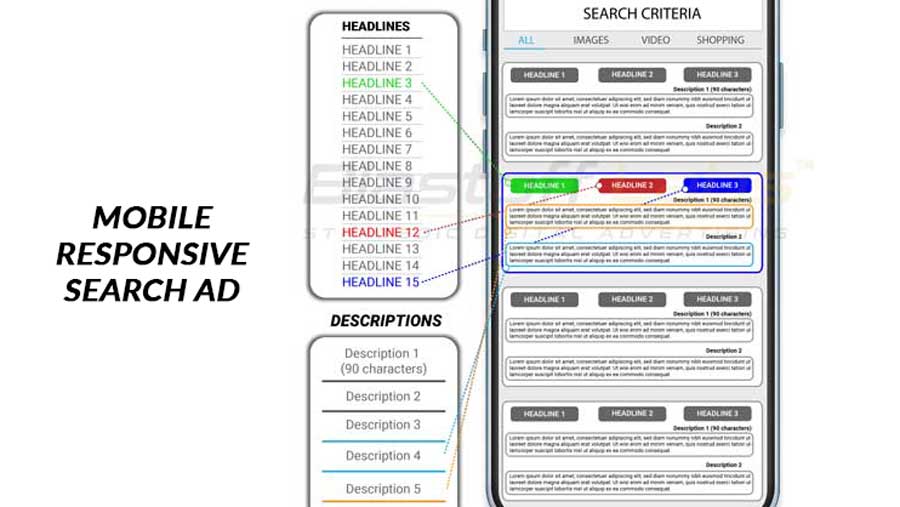
As a responsive ad runs, the copy that the platform approves of is served in different combinations. After enough data accumulates, you will be able to see the different arrangements that the ad copy served in, as shown in the mobile ad screen diagram below.
163,800 Ways to Serve a Single Search Ad
When a responsive ad is created, it is populated with additional ad headlines, descriptions, and media, including images and video. Refer to the diagram for a comparison of a standard text ad to a responsive text ad.
Responsive search ads allow up to 15 headline variants and 5 description line variants to be pre-populated. In a responsive search ad, instead of the usual two or three lines of ad copy, there are 15 headlines. There are 5 descriptions instead of 2.
In a responsive search ad, any of the 15 headlines can be served into one of two or three available headline fields, and any of the 5 descriptions can be served into one of the two available description fields. This diagram shows how ad headline and description ad copy is introduced into a responsive search ad.
The Math of Responsive Ads
By doing a little arithmetic, we can see how many combinations of ad copy may be served by a responsive search ad. The ad shown in the accompanying diagram can be populated with up to 15 headlines and 5 descriptions. As shown, there are three 35-character headlines and two 90-character description slots this copy can be served into. There are therefore 163,800 unique ways this ad can be served.
If we pin, or lock, one ad headline to a position, which is not generally a recommended practice, this comes down to 3,640 combinations. Even the most diligent campaign manager is unlikely to test even a small fraction of these ad copy possibilities during manual split testing.
Responsive ads are served in learning mode until an adequate volume of impressions and clicks is accumulated to learn how different combinations of their ad copy and media perform. They then begin to serve what the platform deems is the best ad copy after winning an ad slot at auction. The ad platforms do not disclose how closely the ads are tailored to suit different auction conditions.
In theory, responsive ads can serve the right media and/or ad copy in the ideal position within the ad to achieve the best result for a given individual auction. In other words, they can generate the highest amount of engagement for that particular ad auction and instance of the ad, measured in click-through rate. This is an extended topic that is beyond the scope of this article.
Semi-Automation of Manual Split Testing
Even veteran ad copywriters end up discarding much of what originally seemed like great ad copy. Strong ads are part marketing-advertising art form and part logical skill set. Great ads rarely come from the first batch of ads in a campaign.
Campaigns that are actively managed by advertisers and PPC pros, along with the ad copy split testing process, consume considerable time and effort after a campaign is launched. When split testing ads, periods of time must lapse between testing new combinations of ads. Otherwise, statistically significant data will not accumulate and mistakes can be made.
PPC pros tend to be aggressive with ad split testing because strong ads are central to campaign performance. But for a high percentage of PPC campaigns, ad optimization simply never takes place. Responsive ads were introduced to address that issue. They shift more effort onto the initial ad setup and introduce automation to reduce the amount of split testing required.
How and When Are Responsive Ads Superior?
In our experience, and from other industry reports and studies, responsive ads can often pull a higher click-through rate and, in our experience, increased overall conversion rates and conversion volumes.
CTR is a useful proxy for conversion rate in new campaigns before there is conversion data available, but it is not always an accurate proxy. People can click on ads for a variety of reasons, including misunderstanding the message. In theory, responsive ads can evolve to learn how to deliver better conversion rates and conversion volume, not just click-through rates.
In our experience, responsive ads are a good complement to traditional ads when they are deployed within the same ad group and used as a new, more automated way to test new ad copy. But because of the limitations on analytics provided, they are somewhat handicapped in that regard.
Can We Measure If a Responsive Ad Is Outperforming a Standard Text or Display Ad?
Yes. The best practice when introducing responsive ads into a campaign is to run one responsive ad alongside two or three traditional text or display ads within an ad group. This allows observation of the relative performance: click-through rates, conversion rates, and cost per conversion.
It is beneficial to introduce at least one-third headline descriptions that are different from the ad copy used in the opposing standard ads. The more unique, well-written ad copy you can create for responsive ads, the better the chances for useful outcomes. This is also where PPC reporting and campaign analysis become important, because performance should be measured against actual business goals, not ad platform automation alone.
What Are the Downsides of Responsive Ads?
The primary issue that advertisers, marketers, and campaign developers have with responsive ads is that the ad platforms are not disclosing many of the most important details of how responsive ads actually work. The analytics on the performance of individual lines of ad copy provided is limited.
Responsive ads, therefore, remain largely a black box to advertisers and agencies. They are useful, but they also have some major issues and limitations that are difficult to sort out due to their proprietary nature.
Advertisers and agencies in certain markets, such as regulated markets or those that tightly control their brand messages, ad quality, and campaigns, may sometimes not approve of ad copy served by responsive search ads, even if it outperforms. This is often for good business reasons.
Some advertisers feel a strong need to control the sequence of ad copy. For example, many advertisers want to serve a unique value proposition in the first headline, followed by features-benefits type information, social proof, and a call to action.
Responsive ads put more control of what ad copy a campaign serves and what order the ad copy serves into the hands of the ad platform. They take control away from advertisers and their agents.
Ad platforms hold a dominant market position, so without much direct competition to be concerned about, they are free to control their ad platforms as they please. Responsive ads are another front in an ongoing struggle between the ad platforms on one side and advertisers and their agencies on the other. Many advertisers are pro-automation but also want to retain the flexibility to optimize more detail of how their ad copy serves.
Responsive ads take a lot more time to initially configure, and that time can sometimes be better invested into manually optimizing ad copy.
On balance, responsive ads are proving to be a promising innovation and a useful tool for many campaigns.
The Bottom Line on Responsive Ad Technology
Responsive display ads quickly became a success because they require fewer images and aspect ratios during setup. They are quicker to set up and less of a variation versus traditional display ads. They also eliminate the requirement to manually populate display ads with many different sizes of the same image. So ad setup time for display is decreased, which is a major benefit. Less ad copy is required as well.
Responsive search ads require more time to configure and can be used to enhance the performance of some campaigns, but they are more controversial.
The key to getting the most out of responsive search ads is to first put the extra effort and time into populating them with strong search ad copy. A responsive search ad can be thought of as an ad copy combination split tester. It will go to work discovering the best combinations of ad copy to serve and the sequence to serve it. This serves to extend the reach and conversion volume of each ad group within a search campaign.
This new type of ad will need to see continued improvements, especially in visibility and reporting, for it to become something that PPC advertisers will become truly enthusiastic about. For related campaign strategy topics, see Blastoff Advertising’s PPC performance articles and PPC campaign management resources. We will have follow-up articles as the situation continues to evolve.
