What Does PPC Campaign Success Look Like?
PPC campaign success is best measured by the business value a campaign produces after accounting for ad spend. Clicks, impressions, traffic, and engagement can be useful indicators, but they do not define success on their own.
For that reason, Blastoff Advertising places the strongest emphasis on Net Advertising Margin, or NAM. ROAS remains useful, but it is a supporting efficiency metric rather than the full definition of campaign success.
For lower-funnel campaigns, success is usually easier to evaluate because the relationship between ad spend, conversions, and conversion value is more direct. With mid-funnel and upper-funnel campaigns, the evaluation can be more complex, but those campaigns can still contribute to conversions when they are measured over the right time frame and connected to a clear conversion value model.
Net Advertising Margin Is the Primary PPC Success Metric
Net Advertising Margin is often a stronger measure of PPC campaign success than ROAS alone because it accounts for both conversion efficiency and conversion volume. ROAS can show whether a campaign is efficient, but NAM shows how much value the campaign produced after ad spend is included.
Net Advertising Margin is calculated as total conversion value minus total ad spend over a specific time period. This gives a clearer view of the value produced by the campaign after advertising cost is included.
For example, a campaign with a very high ROAS but low conversion volume may be efficient, but not especially meaningful to the business. Another campaign may have a lower ROAS but produce a higher Net Advertising Margin because it generates more total conversion value. That distinction matters when evaluating PPC performance.
ROAS Measures Campaign Efficiency
Return on ad spend, or ROAS, measures how efficiently a campaign or account converts ad spend into conversion value. It is calculated as total conversion value divided by total ad spend.
ROAS is an important metric, but it should not be reviewed by itself. A high ROAS does not always mean the campaign is producing the strongest possible business result. It needs to be considered alongside conversion volume, conversion value, lead quality, available budget, and the role of the campaign within the account.
In practical terms, ROAS helps answer whether ad spend is being converted efficiently. Net Advertising Margin helps answer whether the campaign is producing enough total value after ad spend to matter to the business.
Conversion Tracking Is Required to Measure PPC Success
Tracking conversions and assigning value to those conversions is crucial to the medium- and long-term success of PPC campaigns. Without reliable conversion tracking, campaign success cannot be measured clearly.
Conversion tracking gives the advertiser and campaign manager a better view of how much value the advertising investment is delivering. It also sends important performance data back into the advertising platforms, which can support automated bidding and ongoing optimization when the account is structured properly.
Blastoff Advertising uses reporting to review key engagement, conversion, and financial metrics over time. Related areas include PPC reporting and client dashboards.
Conversions Need an Estimated Value
Each conversion type should be assigned an estimated value when developing a conversion value model for the account. That model helps connect campaign performance to the business value each conversion is expected to create.
For Shopping and ecommerce campaigns, valuing conversions is usually more direct because transaction value is reported. In those cases, gross margin by product group can be considered when evaluating campaign performance. Related topics include shopping campaigns, product feeds, and ecommerce client results.
Ad Spend Allocation Can Be a Major Part of PPC Success
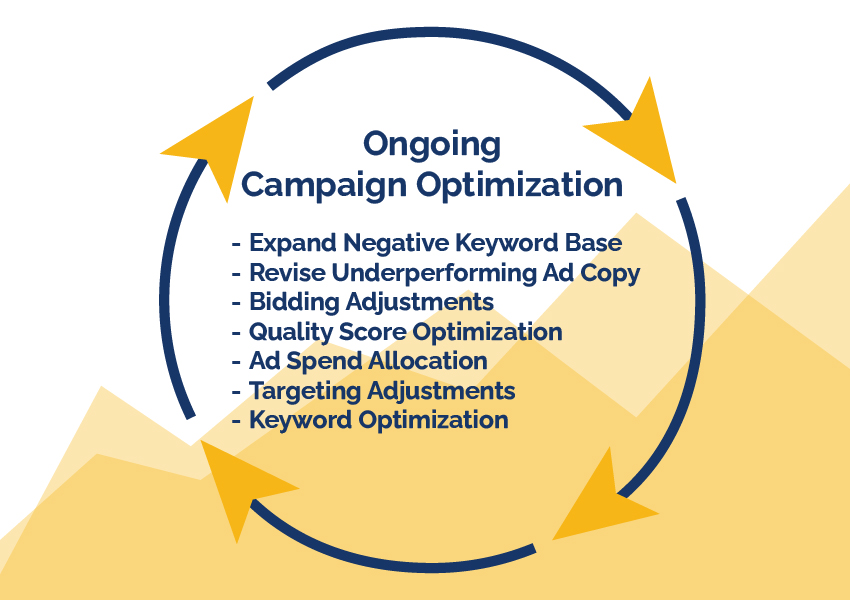
In accounts with more than one campaign, ad spend allocation can be just as important as ongoing optimization inside each individual campaign. If one campaign is producing stronger net value than another, shifting budget can sometimes improve the account’s overall result more than small adjustments inside a single campaign.
Blastoff Advertising uses ad spend allocation analysis to help adjust how budget flows into individual campaigns. This helps align campaign spend with changing market conditions, conversion value, and performance trends. Strong PPC campaign management should look at both individual campaign performance and the way the total account budget is being used.